



 Online stores
 Freight consultation
Tuesday June 16th, 2026
Free Zones and Nearshoring: A Logistics Opportunity for the Dominican Republic
In recent years, one word has gained momentum in conversations about international trade: nearshoring.
Although it may sound like a technical term, its meaning is quite simple. It refers to the decision by many companies to move part of their production, storage, or supply chain closer to the markets where they sell their products.
After years in which many companies concentrated their operations in distant locations in search of lower costs, the world learned an important lesson: producing at a lower cost is not enough. Companies also need to deliver on time, respond quickly, and reduce risk.
The pandemic, international conflicts, maritime delays, rising transportation costs, and changes in trade policies have led many companies to rethink their supply chains.
And in this new global map, the Dominican Republic has a very important opportunity.
Why Nearshoring Matters for the Dominican Republic
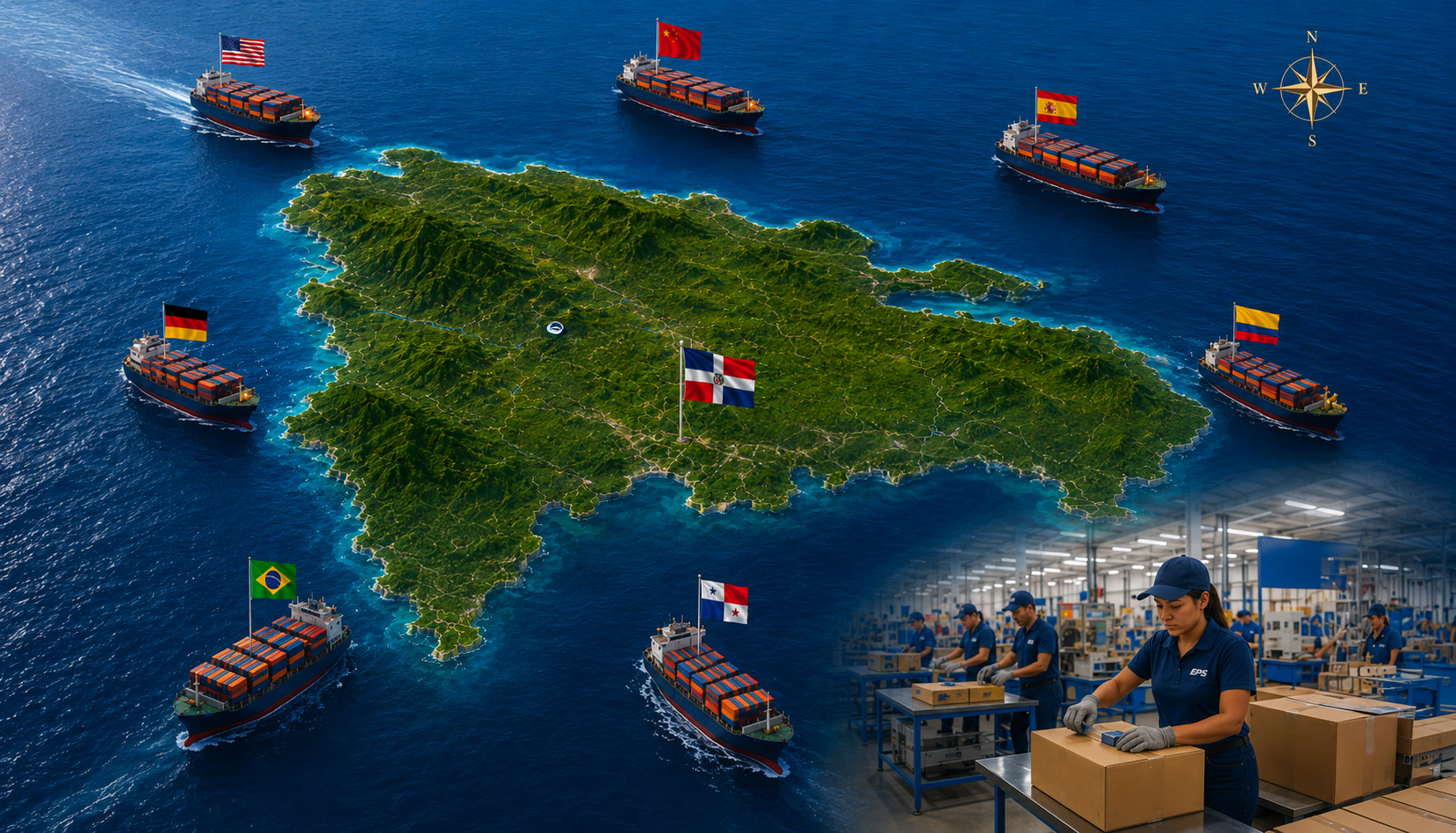
The Dominican Republic has a privileged geographic location, proximity to the United States, maritime and air connectivity, relative macroeconomic stability, export experience, and a free zone regime that has operated successfully for decades.
Dominican free zones have become one of the pillars of the country’s economic growth. According to recent data from the National Council of Export Free Zones, the sector accounts for more than 200,000 jobs, over US$8.6 billion in exports, and 858 companies operating under this regime.
These figures do not only speak to production. They also speak to movement, transportation, storage, distribution, talent, investment, and connection with international markets.
In other words: they speak to logistics.
Free Zones as a Driver of Competitiveness
When we think of free zones, we often think of factories, industrial parks, or exports. But behind every product that leaves a free zone, there is a logistics chain that must operate with precision.
Raw materials must arrive on time. Manufacturing processes depend on imported inputs. Finished products must be shipped to other markets. There is documentation, customs, domestic transportation, and coordination with ports, airports, warehouses, and logistics operators.
A product manufactured in a free zone does not compete only on quality or price. It also competes on its ability to reach its destination quickly, safely, and efficiently.
That is why, the more the free zone sector grows, the more important logistics becomes.
In 2025, the National Council of Export Free Zones approved the installation of 82 new companies and 10 new industrial parks, a sign of the sector’s continued dynamism and its potential to keep attracting investment.
That growth represents opportunities for the country, but also new challenges: more goods to move, more routes to coordinate, more inventories to manage, and a greater need for reliable logistics services.
Nearshoring: A Global Trend With Local Impact
Nearshoring responds to a very clear business need: being closer to the end customer.
For many companies selling in the United States, Canada, Latin America, or the Caribbean, producing or assembling in nearby countries can offer an advantage over operations located thousands of miles away.
Shorter distances can mean reduced transit times, greater flexibility, better response to changes in demand, and less exposure to global disruptions.
This is where the Dominican Republic can play a relevant role.
Our proximity to the United States, regional connectivity, and free zone experience create an attractive combination for companies looking to diversify their supply chains. Recent analyses of the sector highlight that the country has favorable conditions to attract investments linked to nearshoring, although they also point out that the next leap forward will depend on strengthening talent, infrastructure, and public-private coordination.
This is important because nearshoring does not happen automatically. A good location is not enough. A country must demonstrate operational capacity, logistics efficiency, security, talent, technology, and compliance.
Logistics Is What Turns Opportunity Into Reality
Having companies interested in producing closer to their markets is great news. But for that opportunity to become real growth, logistics must be ready to respond.
A company that decides to set up in a free zone or move part of its supply chain to the Dominican Republic needs more than physical space. It needs to know that raw materials will arrive on time, that finished goods can be shipped without delays, that there will be transportation options, that it can distribute within the country or export efficiently, and that it will have partners capable of supporting its operation.
Logistics is the backbone that supports that promise.
Without efficient logistics, nearshoring loses strength. With reliable logistics, the Dominican Republic can become a more competitive platform for companies seeking proximity, speed, and stability.
That is why, when we talk about free zones and nearshoring, we are not only talking about foreign investment. We are talking about jobs, exports, transportation, nationwide distribution, cargo services, technology, talent, and opportunities for Dominican companies that are part of that chain.
The Impact Also Reaches Consumers and Small Businesses
Although nearshoring is often analyzed from a business perspective, its impact can also be felt in everyday life.
When a country strengthens its logistics and industrial capacity, it creates more jobs, diversifies the economy, and generates new opportunities for local suppliers, transportation providers, cargo operators, service companies, workshops, vendors, and small businesses.
It can also improve the availability of certain products, shorten replenishment times, and strengthen the country’s ability to respond to international changes.
In the Dominican context, the growth of free zones does not only represent exports. It also represents an economic network that extends into communities, families, and businesses that benefit directly or indirectly from the movement of goods.
Free zones reached historic employment levels in 2025, surpassing 200,000 direct jobs, according to sector reports. This confirms that their impact goes far beyond industrial parks: it touches the real economy of thousands of households.
The Challenges: Talent, Infrastructure, and Added Value
The opportunity exists, but so do the challenges.
To compete in a world where many countries are trying to attract nearshoring, the Dominican Republic must continue strengthening its infrastructure, logistics processes, innovation capacity, technical training, and value proposition.
It is not just about producing more, but about producing better. It is not just about attracting companies, but about creating an ecosystem capable of supporting increasingly sophisticated operations.
Sector leaders have recently pointed out that the next major step for Dominican free zones will depend on a shared agenda, stronger talent development, and high-impact projects that increase the country’s added value.
This is key. Nearshoring should not be seen only as an opportunity to receive operations that used to be far away. It should be seen as an opportunity for the Dominican Republic to move up in the global value chain.
EPS and the Role of National Logistics
At EPS, we see the growth of free zones and nearshoring as a positive sign for the Dominican Republic.
As the country strengthens its position as a logistics and industrial platform, companies need partners capable of supporting their operations with reliable cargo, courier, and nationwide distribution solutions.
Because goods do not only need to arrive in the country. They need to move within the country. They need to reach a company, a branch, a customer, an office, a warehouse, or a point of sale.
That is where nationwide distribution becomes essential.
With a strong logistics network, companies can better connect their operations, respond more quickly, and take advantage of the opportunities created by the new global trade environment.
At EPS, we remain committed to offering solutions that help individuals and businesses move their shipments safely, quickly, and reliably, supporting the growth of a country that is increasingly positioning itself as a strategic point for regional and international trade.
Conclusion
Nearshoring represents a major opportunity for the Dominican Republic, but that opportunity needs logistics.
Free zones have proven to be a driver of employment, exports, and investment. Now, the challenge is to continue strengthening the country’s ability to move goods, connect markets, and respond efficiently to the new demands of global trade.
Because in this new era, competitiveness does not depend only on where something is produced.
It also depends on how quickly, safely, and reliably a product can reach its destination.
And on that journey, logistics is not a complement.It is a competitive advantage.