



 Online stores
 Freight consultation
Tuesday June 2nd, 2026
Consumer Anxiety: When Logistics Becomes Trust
There is one question millions of consumers ask after making an online purchase:
“Where is my package?”
It may sound like a simple question, but behind it lies something much deeper: expectation, urgency, excitement, uncertainty, and, very often, anxiety.
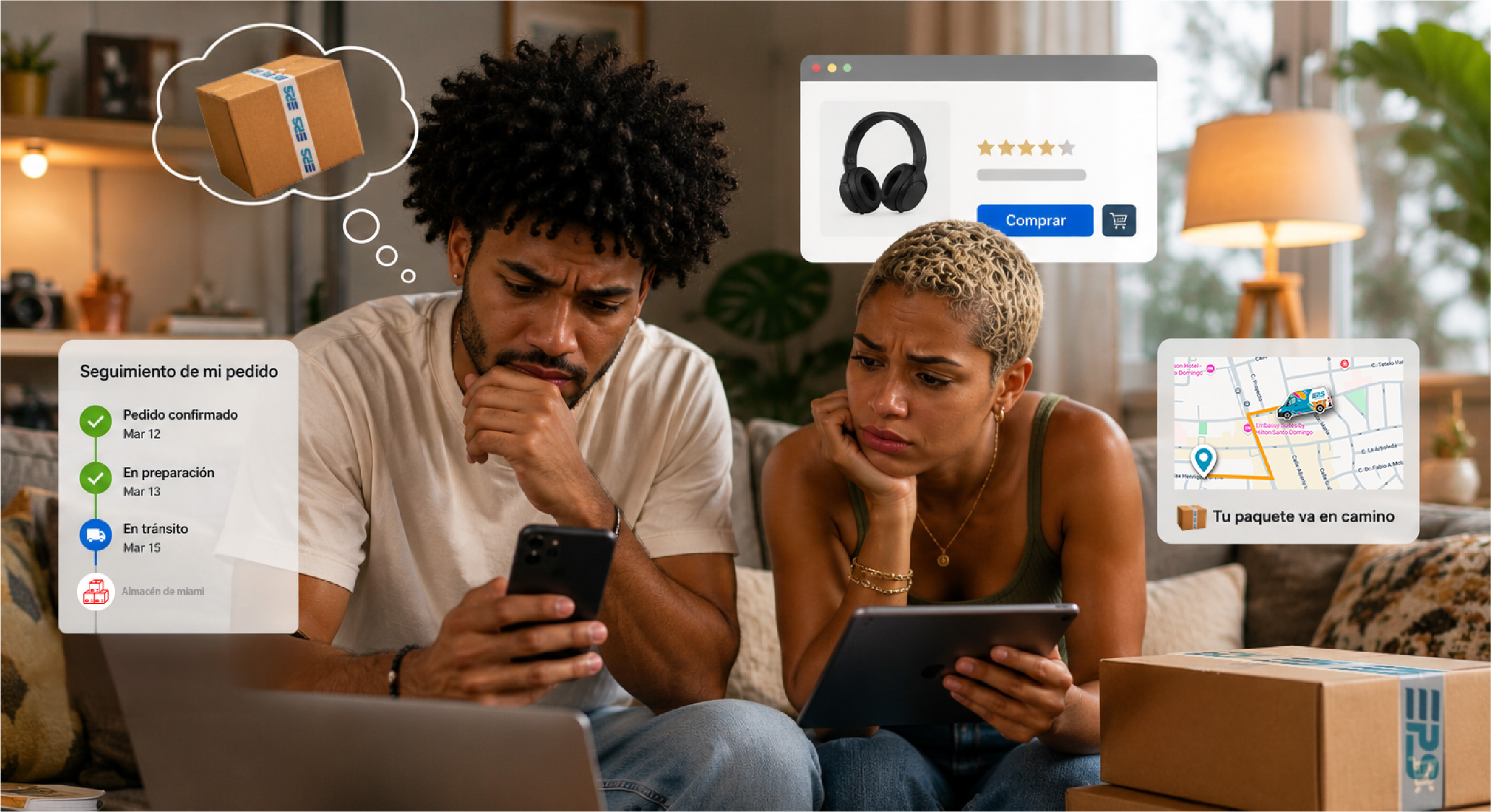
In the past, consumers bought something and waited. Today, they don’t just wait. They want to know when the order leaves, where it is, whether it has arrived in the country, whether it has cleared customs, whether it is out for delivery, whether it is ready for pickup, or whether it is on its way to their home.
Logistics is no longer invisible. Consumers now follow it in real time.
And that is changing how companies, couriers, retailers, and logistics operators must respond.
The Consumer Has Changed: They Don’t Just Buy, They Expect Information
The growth of e-commerce has transformed the relationship between consumers and logistics. Online shopping is no longer limited to large international markets. In the Dominican Republic, more people are buying products online, using courier services, making digital payments, and expecting to receive their packages quickly, safely, and with clear information.
The Central Bank of the Dominican Republic maintains statistics on internet payments, card-not-present transactions, internet banking users, mobile payments, and other indicators that show how digital habits have become part of the country’s economic life.
The implication is clear: the more people shop online, the more people wait for packages. And the more people wait for packages, the more important the logistics experience becomes.
In the Dominican Republic, Courier Services Are Now Part of Everyday Life
For years, courier services were seen mainly as a solution for people buying from the United States. Today, their role is much broader.
They are part of the daily lives of students, professionals, families, entrepreneurs, and small businesses that purchase products, spare parts, tools, technology, clothing, home goods, vehicle parts, cosmetics, medical equipment, work materials, and merchandise for resale.
This growth has also raised consumer expectations. It is no longer enough to say, “Your package is in transit.” Customers want more details. They want to know whether the package arrived at the origin warehouse, whether it was processed, whether it left for the Dominican Republic, whether it is in customs, whether it was released, whether it is ready for pickup, or whether it is on its way to their address.
In other words, consumers do not only want to receive. They want to understand the journey.
Waiting Is Also Emotional
Consumer anxiety is not always about impatience. Very often, it is about need.
Behind a package there may be a birthday gift, an urgent part to repair a vehicle, medicine, an important document, a laptop for work, merchandise for a small business, or a product someone bought with great effort.
That is why, when consumers do not receive information, uncertainty grows.
The question “Where is my package?” does not always mean “I want it faster.” Many times, it means:
“I need to know what is happening.”
“I want to feel that someone is in control.”
“I want to know whether I should be worried.”
“I want to trust.”
That is the new reality of logistics: tracking, notifications, and clear communication have become part of the customer experience.
Delivery Is No Longer Measured Only by Speed
For a long time, logistics competition focused on who could deliver faster. But expectations are changing. Today, consumers increasingly value reliability, flexibility, information, and the ability to choose.
International studies on e-commerce delivery show that shoppers are not only looking for speed; they also expect reasonable costs, delivery options, clear estimated dates, and timely updates.
This offers an important lesson: consumers do not always need everything immediately. Very often, they need the promise to be clear — and fulfilled.
A delivery that arrives in three days with accurate information can build more trust than a delivery promised for tomorrow that no one can explain.
The Last Mile: Where Trust Is Won or Lost
In logistics, the “last mile” is the final stretch: the moment when the package reaches the consumer, a branch, a company, or a pickup point.
Although it may seem like a small step, it is often one of the most complex. It involves routes, traffic, incomplete addresses, schedules, customer availability, calls, delivery attempts, confirmations, and expectation management.
For consumers, this stage is not technical. It is personal.
It is the moment when the promise is either fulfilled or broken.
When the last mile works well, customers feel at ease. When it fails, frustration can affect their entire perception of the experience, even if all previous stages were handled correctly.
In the Dominican Republic, Digital Consumers Also Expect More Response
As more consumers buy, pay, and file claims through digital channels, expectations around protection, transparency, and service also increase.
Pro Consumidor reported that it successfully conciliated more than 93.3% of claims filed during the first ten months of 2025, a figure that reflects the growing importance of customer service and dispute-resolution mechanisms for Dominican consumers.
Although this figure is not limited exclusively to e-commerce or logistics, it does point to a more active, informed consumer who is more willing to file a claim when they feel a company has not delivered on its promise.
In this context, logistics carries a greater responsibility. It is not only about moving packages, but about building trust throughout the entire process.
Anxiety Also Affects Entrepreneurs
This issue does not only affect individual consumers. It also affects small businesses and entrepreneurs who depend on receiving merchandise on time in order to sell, produce, or fulfill commitments to their own customers.
An entrepreneur waiting for merchandise for a fair, an online store that needs to restock inventory, a technician waiting for a part, a hairstylist who bought beauty products, a small business expecting promotional materials, or a company that depends on imported supplies all experience logistics very directly.
For them, a delay is not just an inconvenience. It can mean a lost sale, a missed delivery commitment, or an unhappy customer.
That is why reliable logistics is also a competitiveness tool for small businesses.
More Digital Purchases Mean a Greater Need for Trust
The growth of digital payments and e-commerce in the Dominican Republic shows that consumers are increasingly willing to buy through digital channels.
Local reports, citing Central Bank data, indicated that e-commerce transactions exceeded RD$12 billion in June 2025. This confirms that digital shopping is no longer a distant trend; it is part of the country’s economic behavior.
But every digital transaction creates a physical expectation: that something will arrive, that a service will be fulfilled, that an order will be processed, that a delivery will happen.
That is where logistics becomes the bridge between the digital promise and the real experience.
EPS’s Role: Moving Packages, but Also Delivering Peace of Mind
At EPS, we understand that behind every package there is an expectation.
It may be a personal purchase, a work tool, merchandise for resale, an important document, or cargo that a company needs in order to operate.
That is why modern logistics is not only about speed. It is about visibility, reliability, communication, and trust.
When customers know where their package is, when they can pick it up, what comes next, or what they need to do if information is missing, anxiety decreases. And when anxiety decreases, the experience improves.
In a market where e-commerce is growing, digital payments are advancing, and consumers are becoming more demanding, having a reliable logistics partner makes a difference.
At EPS, we continue strengthening our courier, cargo, and nationwide distribution solutions to support individuals, entrepreneurs, and businesses at every stage of the process.
Because in logistics, we do not only move packages.
We move trust.
We move peace of mind.
We move the assurance that what someone is waiting for will reach their hands with support, information, and commitment.
Conclusion
The question “Where is my package?” captures one of the biggest changes in the modern consumer.
Buying is no longer enough. Shipping is no longer enough. Delivering is no longer enough.
Today, consumers want to know, to trust, and to feel supported.
And that is a major opportunity for logistics companies: to turn waiting into a clear, human, and reliable experience.
Because in the end, every package has a story. And every customer expects that story to end well.