



 Online stores
 Freight consultation
Tuesday May 26th, 2026
How Logistics Impacts the Price of What You Buy at the Supermarket
What You Don’t See at the Supermarket: The Logistics Chain Behind Every Product
When someone walks into a supermarket and notices that rice, cooking oil, vegetables, dairy products, meats, or imported goods cost more than before, they usually think of inflation, taxes, shortages, or increased demand.
And yes, all of those factors matter.
But there is another element that often goes unnoticed: logistics.
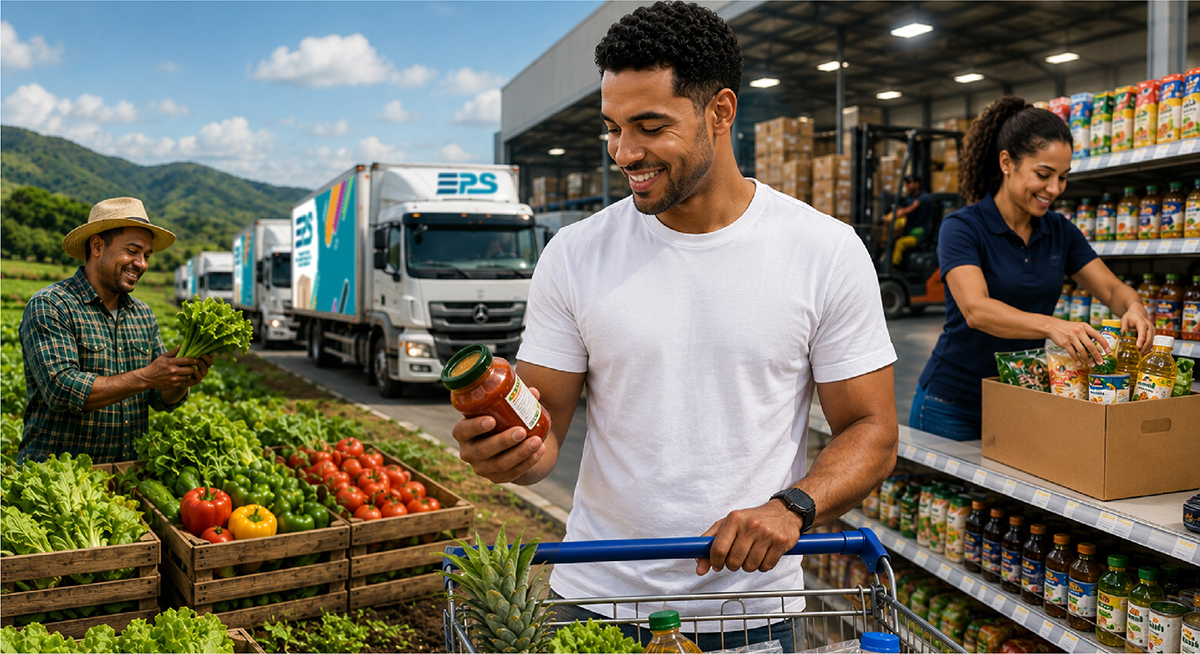
Before a product reaches a shelf, a refrigerated display, or a family’s shopping cart, it has gone through an entire chain: production, packaging, storage, transportation, distribution, inspections, shelf replenishment, and, in many cases, customs procedures.
Each of these stages has a cost. And when any of those costs increases, the impact can end up being reflected in the final price paid by the consumer.
Logistics Is Behind Many Pricing Decisions
In the Dominican Republic, as in many countries that import and consume fresh, processed, and packaged products, logistics plays a key role in product availability and price stability.
A supermarket does much more than sell products. It also manages inventory, storage space, distribution routes, delivery times, shelf replenishment, perishable goods, imported merchandise, and the expectations of consumers who want variety, freshness, and constant availability.
Chains such as Supermercados Nacional, Jumbo, Sirena, Bravo, Olé, Plaza Lama, PriceSmart, and other retailers across the country operate in a market where consumers compare prices, look for promotions, and expect to find both local and imported products in the same place. Local price-comparison platforms even allow users to compare products across chains such as Sirena, Nacional, Bravo, Plaza Lama, PriceSmart, Jumbo, Garrido, and other supermarkets, reflecting a consumer who is increasingly aware of the value of each purchase.
That variety we see in supermarkets depends on a logistics network that works every day, often without consumers ever seeing it.
Why Can the Price of a Product Increase?
Some products become more expensive for direct reasons, such as an increase in the cost of raw materials. But other price increases are explained by what happens along the way.
For example, when fuel prices go up, transporting goods from a port, warehouse, farm, or distribution center becomes more expensive. If there are delays at ports or during customs processes, storage costs can increase. If a product requires refrigeration, maintaining the cold chain requires investment in equipment, energy, specialized transportation, and constant monitoring.
For fresh or perishable foods, a logistics failure can be especially costly. The cold chain, used in farms, trucks, ports, and airports, is essential to preserving the freshness, safety, and quality of foods produced in or transported from the Dominican Republic to other markets. When that chain is not properly managed, products can be lost, damaged, or have a reduced shelf life.
And when losses occur, someone ends up absorbing that cost: the producer, the distributor, the retailer, or, very often, the consumer.
The Basic Food Basket Also Feels the Pressure of Logistics
The cost of the basic family food basket is one of the indicators people feel most directly in their daily lives. In the Dominican Republic, local media have reported, based on Central Bank data, that the national family basket rose from RD$46,420.68 in January 2025 to RD$47,534.46 in September of that same year, an increase of 2.4% in nine months.
Later reports indicated that, by November 2025, the Dominican family basket had reached RD$48,138.35, a figure that places particular pressure on lower-income households, which spend a larger share of their income on food and essential goods.
Although logistics is not the only factor behind these increases, it is an important part of the equation. Food, transportation, fuel, inventory, refrigeration, and distribution are deeply connected.
The World Bank has also warned that rising food and fuel prices have a significant impact on Latin America and the Caribbean, especially on the most vulnerable households, since they dedicate a larger portion of their income to food and transportation.
In other words: when moving products becomes more expensive, the cost of living can also become more expensive.
The Example of Fresh Products
Think about something as everyday as a tray of vegetables, a package of strawberries, refrigerated chicken, yogurt, or a cut of meat.
For that product to arrive at the supermarket in good condition, it must remain within specific temperature ranges. It must be transported quickly, stored properly, and placed on shelves before losing quality.
If that process fails, the product may spoil, lose freshness, or need to be sold at a discount before it expires. In the worst-case scenario, it is lost entirely.
That is why, when we talk about the cold chain, we are not only talking about technology. We are talking about efficiency, food safety, and waste reduction.
In the Dominican Republic, logistics and shipping-sector associations have signed agreements to strengthen cold-chain logistics for food products, precisely because this issue is key to the country’s competitiveness and to reducing losses in sensitive goods.
A stronger cold chain helps food arrive in better condition, last longer, and generate less waste. That benefits producers, retailers, and consumers alike.
Supermarkets as a Visible Example of an Invisible Chain
Consumers see the final result: an organized shelf, a full refrigerated section, a seasonal promotion, or an aisle stocked with imported products.
But behind that image, there are constant logistics decisions being made.
For example, a chain such as Grupo Ramos, operator of brands including Sirena, Aprezio, and Multiplaza, has announced national expansion plans through 2030, including broader territorial coverage. This type of growth does not only mean opening more stores; it also requires stronger supply, distribution, inventory management, and replenishment across new areas of the country.
The same applies to retail groups such as Centro Cuesta Nacional, which operates formats such as Supermercados Nacional and Jumbo and presents itself as a diversified retail group with a broad portfolio of well-known stores and brands in the Dominican Republic.
The larger and more diverse a retail network becomes, the more important logistics becomes. Supplying a store in the National District is not the same as coordinating deliveries to Santiago, Punta Cana, Barahona, La Romana, San Juan, or any other province.
In fact, local media have reported the expansion of supermarket chains into the southern region of the country, with brands such as Sirena, Olé, and Bravo present in cities including Baní, Azua, and Barahona.
For consumers, that expansion means greater access. For companies, it represents a greater logistics challenge: reaching farther, maintaining availability, and doing so profitably.
When Logistics Works, Consumers Barely Notice It
The paradox of logistics is that, when it works well, it often goes unnoticed.
Consumers are not thinking about routes, fuel, warehouses, inventory, temperature, customs, or distribution centers. They simply find the product available.
But when something goes wrong, logistics becomes visible immediately: a product is missing, the price goes up, a delivery is delayed, quality declines, or a brand disappears from the shelf.
That is why efficient logistics does not only benefit companies. It also benefits consumers.
It helps reduce losses, improve timing, preserve quality, optimize routes, avoid reprocessing, and support a more stable product offering.
What Can Consumers Learn From All This?
The final price of a product does not depend only on how much it costs to produce it.
It also depends on how much it costs to move it.
It depends on whether it arrived by ship, plane, or road. Whether it required refrigeration. Whether it went through customs. Whether there were delays. Whether fuel prices increased. Whether the product was damaged along the way. Whether the store needs to restock it daily or store it for weeks.
Every product on a supermarket shelf has a logistics story behind it.
And the more efficient that story is, the better the chances that consumers will receive products that are available, in good condition, and at more competitive prices.
EPS’s Role in Logistics That Impacts Daily Life
At EPS, we understand that logistics is not just about moving boxes.
It is about connecting people with products. It is about helping companies keep their operations running. It is about supporting entrepreneurs who depend on receiving merchandise on time. It is about making sure that a purchase, a spare part, a document, a shipment, or a product gets where it needs to go.
In a country where commerce, consumption, and distribution are constantly evolving, having a reliable logistics partner makes a difference.
Because when logistics works better, daily life works better too.
Behind every product that reaches a store, a business, or a family, there is a chain of efforts that often goes unseen, but that supports a large part of the economy.
And at EPS, we continue working to be part of that chain, with courier, cargo, and nationwide distribution solutions that support our customers in an environment that is increasingly demanding, more connected, and more aware of the value of a job well done.